

Posted by nuréo Skincare
on September 16, 2026
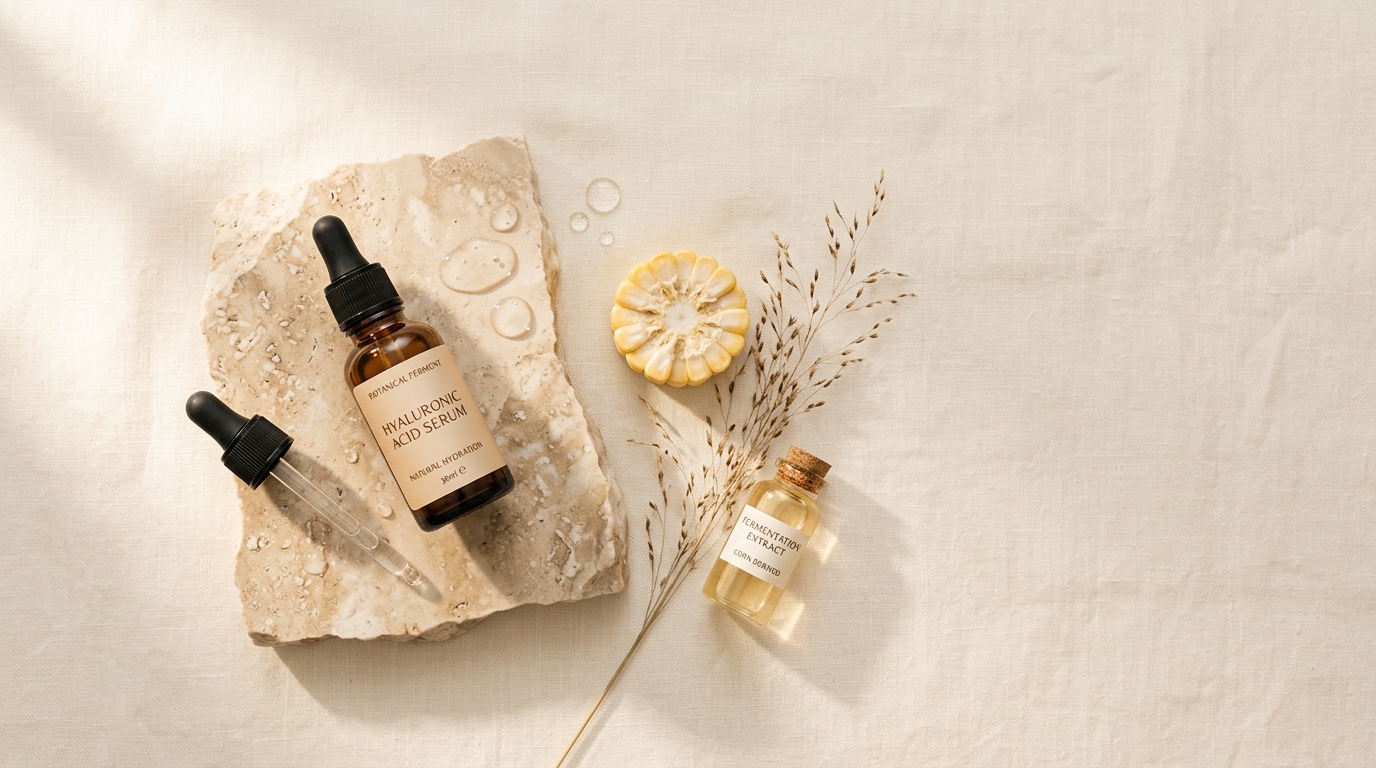
Plant-based hyaluronic acid skincare uses hyaluronic acid produced through microbial fermentation of plant sugars, like corn or wheat glucose, rather than extracted from animal tissue. Nearly all hyaluronic acid sold today (INCI name Sodium Hyaluronate) comes from fermentation, but only formulas that confirm plant-derived growth media and zero animal byproducts can honestly call themselves plant-based and vegan.
Is hyaluronic acid natural or synthetic?
It depends how you define synthetic. Before the 1990s, hyaluronic acid was extracted from rooster combs, an animal source that carried allergen and contamination risk. Most commercial HA today is made by bacterial fermentation, which is biological, not synthesized from petrochemicals, but it isn't automatically "natural" or vegan either.
The strain doing the work matters. Streptococcus equi fermentation historically used animal-derived nutrient broths, while newer processes rely on genetically modified Bacillus subtilis fed exclusively on plant sugars. Only the latter qualifies as truly plant-based hyaluronic acid.
How is plant-based hyaluronic acid actually made?
The process is closer to brewing than chemistry lab synthesis. It typically follows five steps:
- A non-animal bacterial strain is cultured in a sterile tank.
- The bacteria are fed plant-derived glucose, usually from corn or wheat starch.
- As the bacteria metabolize the sugar, they excrete long chains of hyaluronic acid as a byproduct.
- The broth is filtered, purified, and neutralized into sodium hyaluronate salt.
- The resulting HA is separated into specific molecular weight fractions for different skincare uses.
This is why ingredient decks rarely say "plant-based hyaluronic acid" outright. The INCI name is always Sodium Hyaluronate regardless of source, so sourcing claims live in marketing copy, not the ingredient list itself.
What's the difference between high and low molecular weight hyaluronic acid?
Molecular weight determines where the HA molecule can physically go once it's on your skin. This single variable explains most of the confusion around whether hyaluronic acid "works."
| Type | Molecular weight | Where it sits | What it does |
|---|---|---|---|
| High molecular weight (HMW) | Over 1,000 kDa | Surface of the skin | Forms a breathable film that locks in moisture and reduces transepidermal water loss |
| Low molecular weight (LMW) | Under 50 kDa | Upper epidermis | Draws water into skin cells, plumping fine lines from within |
| Ultra-low molecular weight | Under 10 kDa | Deeper epidermal layers | Delivers hydration and may support a mild anti-inflammatory response |
Why do double hyaluron formulas outperform single-weight formulas?
A serum with only high molecular weight HA gives you surface plumpness but nothing deeper. A serum with only low molecular weight HA hydrates the epidermis but leaves nothing to seal moisture in, so it can evaporate faster in dry climates.
Double (or multi-weight) hyaluron formulas combine both fractions on purpose. The high molecular weight chains form a protective barrier while the low molecular weight chains work underneath, hydrating cells that are actually losing plumpness with age. This layered mechanism is why formulators pair multi-weight HA with peptides, since peptides signal collagen production while HA keeps the environment hydrated enough for that signaling to happen efficiently. Our Peptide Youth Boost Serum uses this exact logic, and it pairs well with the layered hydration approach we cover in our guide to how peptides work in skincare.
Is plant-based hyaluronic acid actually better than animal-derived?
Honestly, once purified, sodium hyaluronate performs identically on skin regardless of its starting source. The molecule itself doesn't carry a memory of whether it came from a rooster comb or a fermentation tank.
The real differences are in safety and ethics, not efficacy:
- Animal-derived HA carries a small but nonzero risk of protein contaminants or allergens.
- Plant-fermented HA is more batch-consistent, since fermentation conditions are tightly controlled.
- Plant-based HA is cruelty-free and compatible with vegan certification, which animal-derived HA never is.
So "better" here is a clean beauty argument, not a performance argument. If your priority is sourcing transparency and avoiding animal byproducts entirely, plant-fermented HA is the clear choice.
How can you tell if a hyaluronic acid serum is truly plant-based?
Since the INCI name never changes, you have to look past the ingredient list. A few practical checks:
- Look for brand disclosure about fermentation media, not just the word "vegan" on the front label.
- Check for third-party vegan certification, which requires supply chain documentation.
- Favor multi-molecular-weight complexes, since that formulation detail signals a more considered, up-to-date formula.
- Be skeptical of products blending HA with animal-derived collagen or elastin, since that undercuts a plant-based claim even if the HA itself is clean.
Our GlowGuard Anti-Aging Cream pairs multi-weight hyaluronic acid with plant antioxidants instead of animal-derived actives, which keeps the whole formula consistent with a clean beauty label rather than just one hero ingredient.
Does hyaluronic acid replace retinol or vitamin C in an anti-aging routine?
No, and this is a common misconception. HA is a humectant, it holds water, it doesn't stimulate collagen or exfoliate turnover the way retinoids or ascorbic acid do.
Think of HA as the delivery vehicle that makes other actives work better, not a replacement for them. If you're building a full routine, our posts on natural retinol alternatives for sensitive skin and natural vs synthetic vitamin C absorption cover how to layer those actives alongside a hyaluronic acid base without irritation.
FAQ
Is hyaluronic acid vegan by default?
No, not automatically. Hyaluronic acid is vegan only when it's produced via fermentation using plant-derived nutrient media and no animal byproducts anywhere in the process, which brands should be able to confirm on request.
What molecular weight of hyaluronic acid is best for fine lines?
A blend works better than any single weight. High molecular weight HA seals the surface to prevent water loss, while low and ultra-low molecular weight HA penetrate deeper to plump the layers where fine lines actually form.
Can I use hyaluronic acid serum with vitamin C or retinol?
Yes, and it's actually recommended. Apply hyaluronic acid on damp skin first to maximize water binding, then layer vitamin C or a retinol alternative on top, finishing with a moisturizer to lock everything in.
How often should I apply a hyaluronic acid serum?
Twice daily is standard, morning and night, applied to slightly damp skin. HA needs ambient moisture to draw from, so applying it to bone-dry skin in a very dry climate can occasionally have the opposite effect.
Does plant-based hyaluronic acid break down faster than animal-derived HA?
No, stability depends on molecular weight and formulation antioxidants, not the original source of the HA. A well-formulated plant-fermented serum with proper packaging will be just as shelf-stable as one using animal-derived HA.
